“Hello America, this is W0EMP. We’re in Emporia, and we’d like to talk with you.”
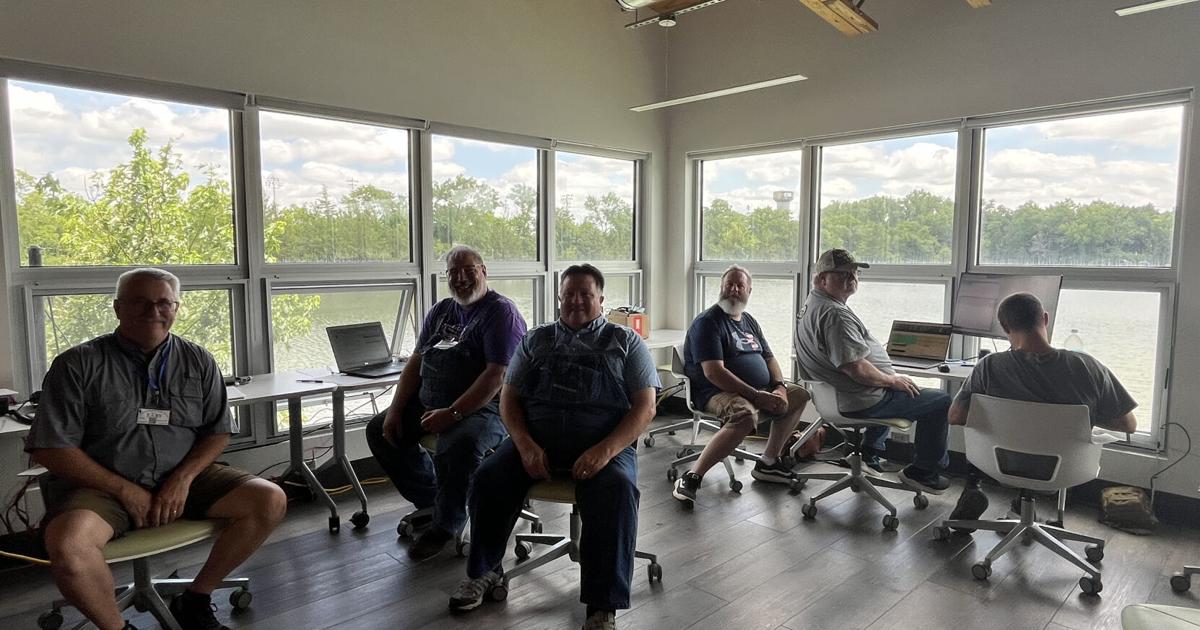
The call rang out hundreds of times from the Prophet Aquatic Research and Outreach Center (PAROC) Saturday afternoon. Members of the Emporia Amateur Radio Society (EARS) manned two temporary ham radio stations with one simple goal – reach as many people across the country as possible.
The annual Field Day exercise has been hosted by the National Association for Amateur Radio since 1933. Over 30,000 ham radio operators try to make contact with their fellow radio enthusiasts, and each contact generates at least one point. Whoever compiles the most points wins.
Dr. Joseph Laudie, a licensed radio operator with EARS said that as of 2:30 p.m., the station had received 23 contacts. The temporary station was active from 1 p.m. Saturday to 1 p.m. Sunday. On average, they receive at least several hundred contacts.
“When we get done with this after 24 hours, if we can manage that whole time, we’re hoping for about 400 contacts here,” Laudie said.
The purpose of the field day is to test emergency communications. According to Laudie, ham radios are one of the most reliable forms of communication in the wake of a natural disaster. While other communication methods, such as cell towers, might be down, very few instances can interfere with ham radio transmission.
“This [Field Day] gives us a chance to practice all of that,” Laudie said. “We’re making sure that when the potentially worst case scenario happens, that we already know the route, what we’re going to do. We’ve done this. We know how to do it.”
If a natural disaster were to happen in Emporia, the EARC could connect local residents with long-distance loved ones to let them know they’re safe.
“We would work with the local citizens,” Laudie said. “We’d set up a table in the mall parking lot, set up this portable equipment and say, ‘okay, who do you need to talk to outside of Emporia and let them know that you’re okay?”
The EARC set up two radios for its field day. Several members operated a traditional ham radio, making contact by speaking into a mic. Relatively new to the amateur radio scene, a digital ham radio was set up to receive messages by text. The EARC brought portable radio antennas and powered its equipment with battery units and solar power.
Using a traditional ham radio, a radio operator can speak to one person at a time. A digital ham radio can connect to 20 to 30 stations at the same time.
Laudie described a typical conversation between ham radio operators as an exchange of information. A radio operator sends out a signal to the rest of the world, identifying themselves with a unique call sign. Each radio operator is assigned a call sign when they earn their license. EARC’s club call sign is W0EMP.
Anyone who hears EARC can respond and share where they’re based. The digital ham radio logs all information digitally, while the traditional ham radio operator records everything manually.
“Because it’s [Field Day] a contest, there’s certain things I have to tell them,” Laudie said. “We have to tell them how many stations we’re running and what state we’re in. They’ll do the same and then our computers automatically say, ‘well, thank you, we got the information.’ That handshake of information gets done and then it logs it for us.”
Although the Field Day event is focused mainly on U.S. calls, ham radios can reach almost anywhere in the world. Many EARC radio operators have made contact with places in Europe, South America, and Puerto Rico.
Achieving a ham radio license requires a $10 test, which can be administered by a EARC operator in Emporia, and access to radio equipment, which can start at $30 to $40. For more information about ham radio or EARC, contact Tim East at 316-200-6037 or visit www.arrl.org/what-is-ham-radio.
:quality(100) "5 Takeaways on Secure Communications from CGE Radio’s Conversation with BlackBerry")