
ISRO warns of radio blackouts as M and X-class solar flares hit Earth: Check what the X8.3 flare is and its effects
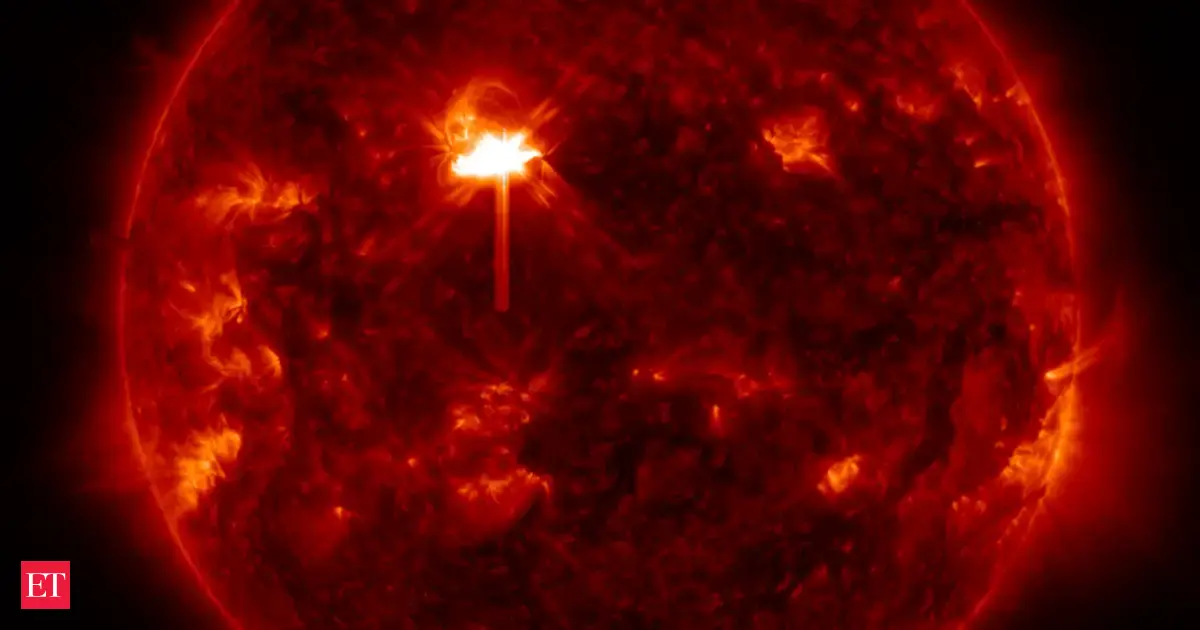
ISRO officials said more than 50 operational Indian satellites are being monitored continuously, as intense solar storms can interfere with radio signals, satellite operations, radars and power grids. Solar flares directed towards Earth disturb the ionosphere, the upper layer of the atmosphere that supports long-range radio communication.
“There is a strong possibility of radio blackouts. All ISRO satellites are being monitored very closely,” Anil Kumar, Director of ISRO’s Telemetry, Tracking and Command Network (ISTRAC), told NDTV. He added that any communication loss would be addressed immediately, with ground stations issuing alerts to mission control centres and contingency plans in place to handle anomalies without delay.
Recent surge of solar flares
Over the past 24 hours, the Sun has released at least 18 M-class flares and three X-class flares, including an X8.3 flare—the strongest solar flare recorded so far in 2026. Solar flares are sudden bursts of energy from the Sun, classified by strength from A, B, C, M to X, with each step representing ten times more energy. X-class flares are the most intense explosions the Sun can produce, and an X8.3 flare sits very high on this scale.
This activity is coming from a rapidly growing sunspot, Active Region 4366, which has expanded over the past few days and exhibited unstable magnetic behaviour. The X8.3 flare peaked at 6:57 pm EST on February 1, releasing strong ultraviolet and X-ray radiation that disturbed the upper layers of Earth’s atmosphere. Parts of the South Pacific experienced R3-level radio blackouts, and shortwave radio signals were disrupted in eastern Australia and New Zealand, according to the US National Oceanic and Atmospheric Administration’s Space Weather Prediction Center.

Potential impact and ongoing monitoring
Scientists are closely monitoring for any coronal mass ejections (CMEs) linked to these flares. Early assessments suggest most of the solar material from the X8.3 flare may miss Earth, though a slight impact is possible around February 5, which could briefly increase geomagnetic activity and raise chances of auroras at higher latitudes.
Sunspot 4366 remains active and is turning more directly towards Earth, with forecasters expecting further solar activity from this region in the coming days. High-intensity flares like these release electromagnetic radiation that can disrupt communication and navigation signals, and increase radiation risks for satellites and high-altitude flights, especially near the polar regions.
link
:quality(100) "5 Takeaways on Secure Communications from CGE Radio’s Conversation with BlackBerry")