Radio enthusiasts to the rescue in emergency communications | Western Colorado
For many participants in the world of amateur radio, the initial draw can be something like the ability to talk to people from around the world.
“It starts as a hobby. You want to talk to somebody because you hear somebody else talking,” said local amateur radio enthusiast Ralph Grover.
But for a lot of people involved in amateur radio, also known as ham radio, it’s not just for the fun of it. Amateur radio can play an important role in emergency communications, and many people involved with it are here to help.

Larry Robinson/The Daily Sentinel
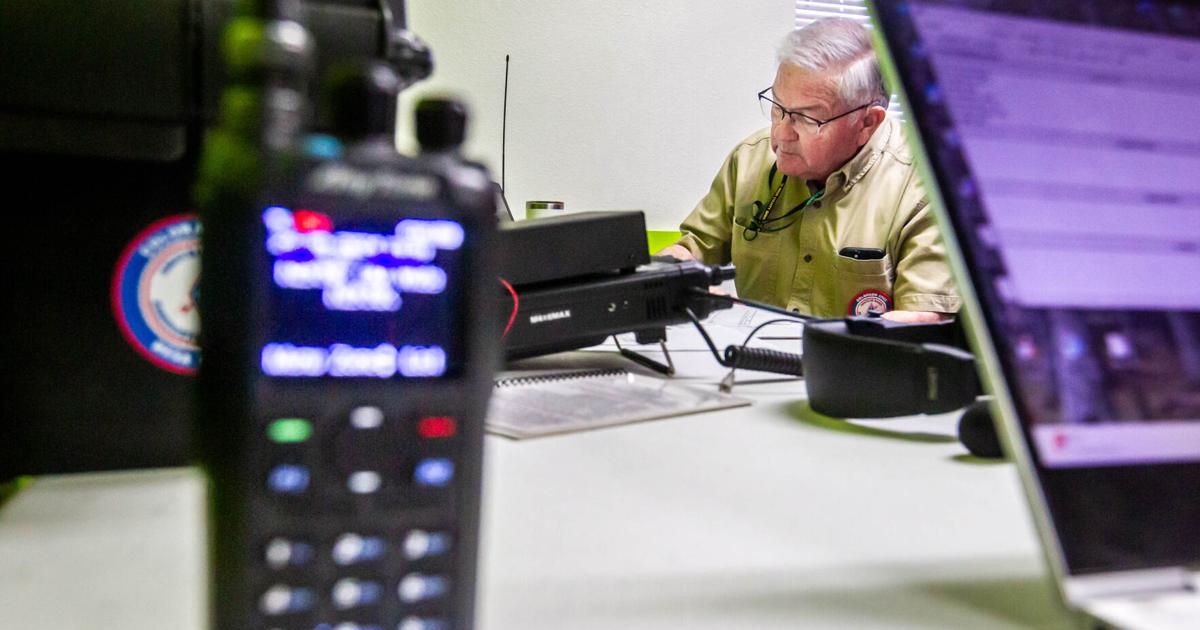
Ralph Grover, left, uses a radio during the ARRL (American Radio Relay League) Colorado Simulated Emergency Test on Oct. 26, 2024. The ARRL is designed to facilitate emergency communications on the civilian side when first responders may need additional support, or support before they can deploy in the field.
“I’ve been involved with ham for about 30 years. Emergency communications has always been my interest,” said Chip Ferron, who is involved with Mesa County Amateur Radio Emergency Service (MCARES) and is coordinator of Region 9, the northwest region of Colorado ARES. Nationally, ARES is a branch of ARRL, a national association for amateur radio originally formed as the American Radio Relay League.
ARES is designed to facilitate emergency communications on the civilian side when first responders may need additional support, or support before they can deploy in the field, Grover said. He said there are a lot of ARES members around the country who can be called on quickly to mobilize at the beginning of an event to help out with emergency communications and then step aside when the authorities move in.

Larry Robinson/The Daily Sentinel
Chip Ferron, left, Emergency Coordinator for Mesa County ARES (Amateur Radio Emergency Service) uses a radio to talk to personnel around the state during the ARRL (American Radio Relay League) Colorado Simulated Emergency Test on Oct. 26, 2024. The simulation was an exercise to test the readiness and emergency-operating skills of members through a series of simulated scenarios in the case of an electrical blackout and other disasters.
“It’s one of those things, it’s very much under the radar, but there’s a strong community effort to make sure we as a community can at least be prepared and supported where we can provide that support,” he said.
“The amateur radio community is pretty important to me as an emergency manager,” said Andy Martsolf, emergency services director for Mesa County.
As it happens, Martsolf has held an amateur radio license since the early 1990s, “so I count myself as one of them,” he said.

Equipment used during the ARRL (American Radio Relay League) Colorado Simulated Emergency Test, an exercise to test the readiness and emergency-operating skills of members through a series of simulated scenarios in the case of an electrical blackout and other disasters on Oct. 26, 2024. Nearly 300 people across Colorado participated in the test ranging from the Grand Valley, to the Grand Mesa, and all the way to Denver.
He said he’s not active in amateur radio these days but had made sure not to let his Federal Communications Commission license lapse because it’s a bit of a process to get the license. He said getting into amateur radio at the time he did was a bit of a natural thing to do, as his career field was communications when he served in the Air Force.
He said amateur radio enthusiasts are an important part of the emergency operations plan for the county. Facilities are in place for them in the county’s emergency operations center in case there is a need to establish some sort of long-haul communications to the state emergency operations center.
“To me they’re important because they offer multiple modes of radio communication. Public safety radio communications tend to be limited to one mode, so if there’s a failure there then it leaves the potential for gaps in radio communications,” Martsolf said.

Antenna towers and wires scattered the ground at the First Christian Church as Grand Junction members set up for the ARRL (American Radio Relay League) Colorado Simulated Emergency Test, an exercise to test the readiness and emergency-operating skills of members through a series of simulated scenarios in the case of an electrical blackout and other disasters on Oct. 26, 2024. Nearly 300 people across Colorado participated in the test ranging from the Grand Valley, to the Grand Mesa, and all the way to Denver.
EARLY DAYS
Martsolf said that in the early days of the county’s COVID-19 response, one of the first objectives at the county emergency operations center was to establish a call center.
“It’s the amateur radio community that I looked to help staff the phones for that call center,” he said.
Beyond the assistance amateur radio enthusiasts provide for emergency operations, they also help with communications for multiple special events throughout the year, such as running races and gravel bike races, some of which take place “in the middle of nowhere,” Martsolf said.

Randy Stringer writes down on a piece of paper during the ARRL (American Radio Relay League) Colorado Simulated Emergency Test, an exercise to test the readiness and emergency-operating skills of members through a series of simulated scenarios in the case of an electrical blackout and other disasters on Oct. 26, 2024.
“That gives us additional training,” said Grover.
On other occasions amateur radio enthusiasts who want to help with emergency communications have the opportunity to engage in training in a much bigger way. One of those occasions occurred on Oct. 26, as part of a nationwide exercise involving a simulated emergency.
In Colorado, Ferron and Grover say probably more than 100 people participated in the exercise. Ferron says around 25 were from Mesa County and northwest Colorado.

Keri Varela mans a portable emergency communications trailer during the ARRL (American Radio Relay League) Colorado Simulated Emergency Test on Oct. 26, 2024.
Grover said the exercise involved mobilizing to address what was referred to as a grid failure caused by a cyber attack. The simulation included shutdowns of cellphone services and police radio systems as a result of cyber attacks.
Grover said he served as what was referred to as an inject coordinator for Region 9 in northwest Colorado.
“My job was to develop additional issues and hand them to radio operators — to say this or that is happening and see how they respond — because no emergency is just a standard emergency. Things happen in the middle of them and so you try to prepare for those too,” he said.

An ARRL (American Radio Relay League) hat hangs from a divider wall during the ARRL Colorado Simulated Emergency Test, an exercise to test the readiness and emergency-operating skills of members through a series of simulated scenarios in the case of an electrical blackout and other disasters on Oct. 26, 2024. Nearly 300 people across Colorado participated in the test ranging from the Grand Valley, to the Grand Mesa, and all the way to Denver.
“… What we tried to do as a group in the state is to respond to additional mobilizations as each one of these attacks occurred.”
Grover said local amateur radio signal repeaters all are backed up with battery or solar power.
“So when the grid quote unquote ‘went down,’ we managed to maintain our repeaters fairly effectively,” he said.

Bill Tillery and Chris Carson watch for radio communications from the Grand Mesa during the ARRL (American Radio Relay League) Colorado Simulated Emergency Test, an exercise to test the readiness and emergency-operating skills of members through a series of simulated scenarios in the case of an electrical blackout and other disasters on Oct. 26, 2024. Nearly 300 people across Colorado participated in the test ranging from the Grand Valley all the way to Denver.
SIMULATED EMERGENCIES
Ferron said the Northwest Colorado region of ARES has participated in the simulated emergency event for a number of years. He said that for the first time, it had people working out of an incident communications center in Meeker. The region also worked with participants in the Delta/Montrose/Gunnison county region and the Four Corners area.
“We extended our reach a little bit this year and we were tickled about that,” he said.
Western Colorado participants also engaged in communications with counterparts on the Front Range. Ferron said local amateur radio enthusiasts are able to coordinate with counterparts there and with the state Emergency Operations Center in the event of things like a major snowstorm or grid outage.

Chip Ferron, left, Emergency Coordinator for Mesa County ARES (Amateur Radio Emergency Service) holds a radio while talking to Chris Carson and Cathy Maddox during the ARRL (American Radio Relay League) Colorado Simulated Emergency Test, an exercise to test the readiness and emergency-operating skills of members through a series of simulated scenarios in the case of an electrical blackout and other disasters on Oct. 26, 2024. Nearly 300 people across Colorado participated in the test ranging from the Grand Valley, to the Grand Mesa, and all the way to Denver.
He said typically emergency communications in the state are set up by the Colorado Department of Homeland Security and Emergency Management, which runs the state Emergency Operations Center. ARES volunteers coordinate with the state, but a number of them from Grand Junction and across the state also participate in Colorado Auxiliary Communications, or AuxComm, a volunteer-based state public safety communications unit that supports the state.
Ferron said amateur radio enthusiasts worked with the state AuxComm coordinator during the October exercise.
Local participants worked out of a base at the First Christian Church in Grand Junction for the training event. Grover said the exercise, with all the simulated scenarios being thrown at participants, could be hectic at times.

Keri Varela, left, uses a computer at a portable emergency communications trailer during the ARRL (American Radio Relay League) Colorado Simulated Emergency Test, an exercise to test the readiness and emergency-operating skills of members through a series of simulated scenarios in the case of an electrical blackout and other disasters on Oct. 26, 2024. Nearly 300 people across Colorado participated in the test ranging from the Grand Valley, to the Grand Mesa, and all the way to Denver.
“The only way to test capabilities is to go through it. It can be pretty intense,” he said.
On Dec. 7, amateur radio enthusiasts in the United States also held the 25th anniversary of an event known as SKYWARN Recognition Day. It honors the contributions of SKYWARN volunteers who use amateur radio and other means of communication to provide real-time ground-truthing of weather conditions to National Weather Service offices. The volunteers also can provide communications between the weather service and local emergency management officials when other communications go down.

Ralph Grover, right, points to a sheet alongside Keri Varela during the ARRL (American Radio Relay League) Colorado Simulated Emergency Test on Oct. 26. During the exercise, Grover served as what was referred to as an inject coordinator for Region 9 in northwest Colorado. “My job was to develop additional issues and hand them to radio operators — to say this or that is happening and see how they respond — because no emergency is just a standard emergency. Things happen in the middle of them and so you try to prepare for those too,” he said.
The Dec. 7 event included a special exercise in which amateur stations worked to exchange information with as many SKYWARN weather spotters and National Weather Service stations as possible on various radio bands.
Grover said amateur radio enthusiasts are particularly busy in the southeastern United States pitching in with emergency communications and they participate in more training as a result. He said they play a big role after hurricanes helping transmit welfare messages between people who are trying to check on each other and get word out that they’re OK when communications networks are down.
He said that while amateur radio enthusiasts in western Colorado enjoy practicing, they are thankful that they don’t have as many emergencies to be participating in because that would mean a lot of lives and property would be at risk.
“But we want to try to be prepared so we exercise,” he said.
Ferron said there are a thousand things you can do with amateur radio, and one thing a lot of people, himself included, like to use it for is to give back to the community.
Martsolf said emergency communications support is “kind of baked into amateur radio.”
Anyone interested in learning more about getting involved locally in amateur radio as an emergency-service tool can visit the Mesa County ARES website, www.ares-mesacounty.org.
link
:quality(100) "5 Takeaways on Secure Communications from CGE Radio’s Conversation with BlackBerry")