Regenerative ag conference connects growers, learning from each other
For Zach Mader, trying something different on the farm has come with plenty of trial and error.
“I’ve made a lot of mistakes and I continue to make mistakes, but I see value in,” Mader said.
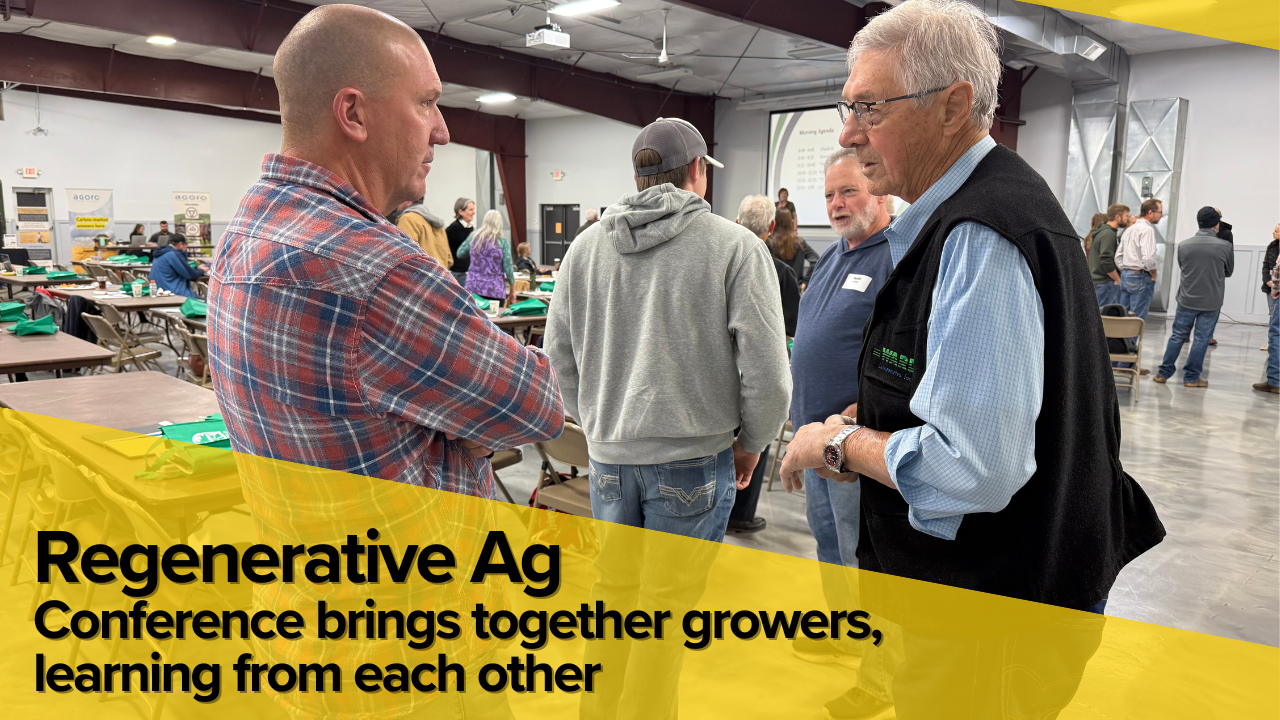
Mader, a farmer near Grand Island, has spent more than a decade experimenting with regenerative agriculture, an approach focused on restoring soil health and rethinking traditional farming practices. He was among those who gathered recently in Holdrege for the fourth annual Central Nebraska Regenerative Agriculture Conference, hosted by Central Community College.
Mader said his approach often stands out among neighbors.
“I get a lot of that actually in my in my neck of the woods,” he said. “But, I just view agriculture a little bit differently. And then doing a lot of different things on my farm.”
Those practices include a diverse crop rotation.
“So I’m growing like a four or five crop rotation. Non-GMO food grade corn, soybeans, milo, cereal rye,” Mader said.
In addition to row crops, Mader grazes cattle on multi-species cover crops through the winter, a system that keeps living roots in the soil while reducing feed costs.
“When you get it seeded in late July, early August, you have a lot of forage,” he said. “And they do really well on it. It’s kind of like a buffet. They get to choose whatever they want, then they get to pick through it and, they seem to do well on it.”
Central Community College Associate Dean Dan Gettinger said the conference began four years ago as a way to help farmers better understand regenerative agriculture and its potential benefits.
“So I had been looking at regenerative ag,” Gettinger said.
He said organizers wanted to focus on both the environmental and economic impacts for producers in the region.
“Benefits that has both ecologically and financially for farmers,” Gettinger said. “And also, we were looking at how could Holdridge area reach out because it is a main farming area. And so they, were interested in picking this up and, developing this.”
Over the years, the conference has drawn speakers from across the country. This year’s keynote speaker was Ray Archuleta, a Missouri-based soil health advocate and retired USDA soil health specialist known to many as “Ray the Soil Guy.”
“Mimic nature,” Archuleta said. “Because people ask me, what is regenerative agriculture? Pretty simple. How do you emulate nature’s designs, patterns and how to work with it?”
Archuleta now teaches farmers worldwide how to restore degraded land by mimicking natural systems. He said understanding soil biology is foundational to regenerative practices.
“But the number one thing to understand is the soil is alive,” Archuleta said, “Once you understand it’s alive, it changes all your perspective. It changes the way you manage.”
He said nature provides a model for soil health.
“The things that nature teaches is that she’s always covered. So service crops, I call over crops. And grazing animals,” he said.
By combining those elements with soil biology, Archuleta said farmers can improve nutrient cycling and reduce reliance on inputs.
“Bring those things together,” he said. “And the third thing we’re using now is microbes in biology to stimulate more of the nutrient cycling. So, learning how to use those logistically in a giant strategy.”
“And understand that everything’s connected. Everything’s one. We help farmers get off fertilizer and chemicals,” Archuleta said.
Archuleta emphasized that regenerative agriculture does not offer quick fixes.
“You have to be intentional. You can’t give up,” he said. “You have to learn for the rest of your life. There’s no easy button.”
“I tell farmers and ranchers, you got into the most difficult job on the planet,” Archuleta added. “You farm and you ranch. I’m sorry. It’s not easy.”
That message resonated with Mader, who said the long-term results make the learning curve worthwhile.
“And having a living road at all times is great for your soil,” Mader said. “The biology, responds to having a living root, integrating the livestock. Spent a big portion of that, plus changing crops, is also feeds the soil. So it’s been there’s lots of benefits.”
Organizers and speakers said conferences like this also provide something less tangible but equally important — connection.
“Yeah, these are great events,” Mader said. “I mean, if nothing else, you have to learn to take baby steps.”
From soil biology to social support, speakers said the regenerative agriculture movement is gaining ground, and events like the one in Holdrege help farmers know they are not alone.
Central Community College said it has become an annual event in Holdrege and they encourage people to watch for it again next fall.
link