OSU Amateur Radio Club embraces tradition while in new era of communication
Tuesday, February 4, 2025
Media Contact:
Tanner Holubar | Communications Specialist | 405-744-2065 | [email protected]
Radio waves first created a phenomenon in Oklahoma more than 100 years ago. For the
first time, people could hear someone speak from miles away, all from the comfort
of their own homes.
It was almost like magic, inspiring people to learn as much about radio as possible.
This enthusiasm turned radio into a hobby, with individuals taking to the airwaves
in a non-commercial way. Known as amateur radio, the hobby has been enjoyed for decades.
Oklahoma State University, then Oklahoma A&M College, created one of the first amateur
radio clubs in the U.S. in 1924, located on the fourth floor of what is now Engineering
South. Part of the setup was a dipole antenna along the roof, and the derricks that
held the antenna were still visible more than 100 years later.
Engineering students and faculty were able to immerse themselves in rapidly advancing
technology, creating an outlet for innovation.
Under the call sign W5YJ, radio as a hobby continued to advance at OSU through the
decades. Over the years, the club became inactive until it rebooted in 2024.
Bringing back a legacy
In this new era for the OSU Amateur Radio Club, focus is placed on continuing the
original values of learning and technical expertise. The club also wants to expand
into more digital and emergency communication.
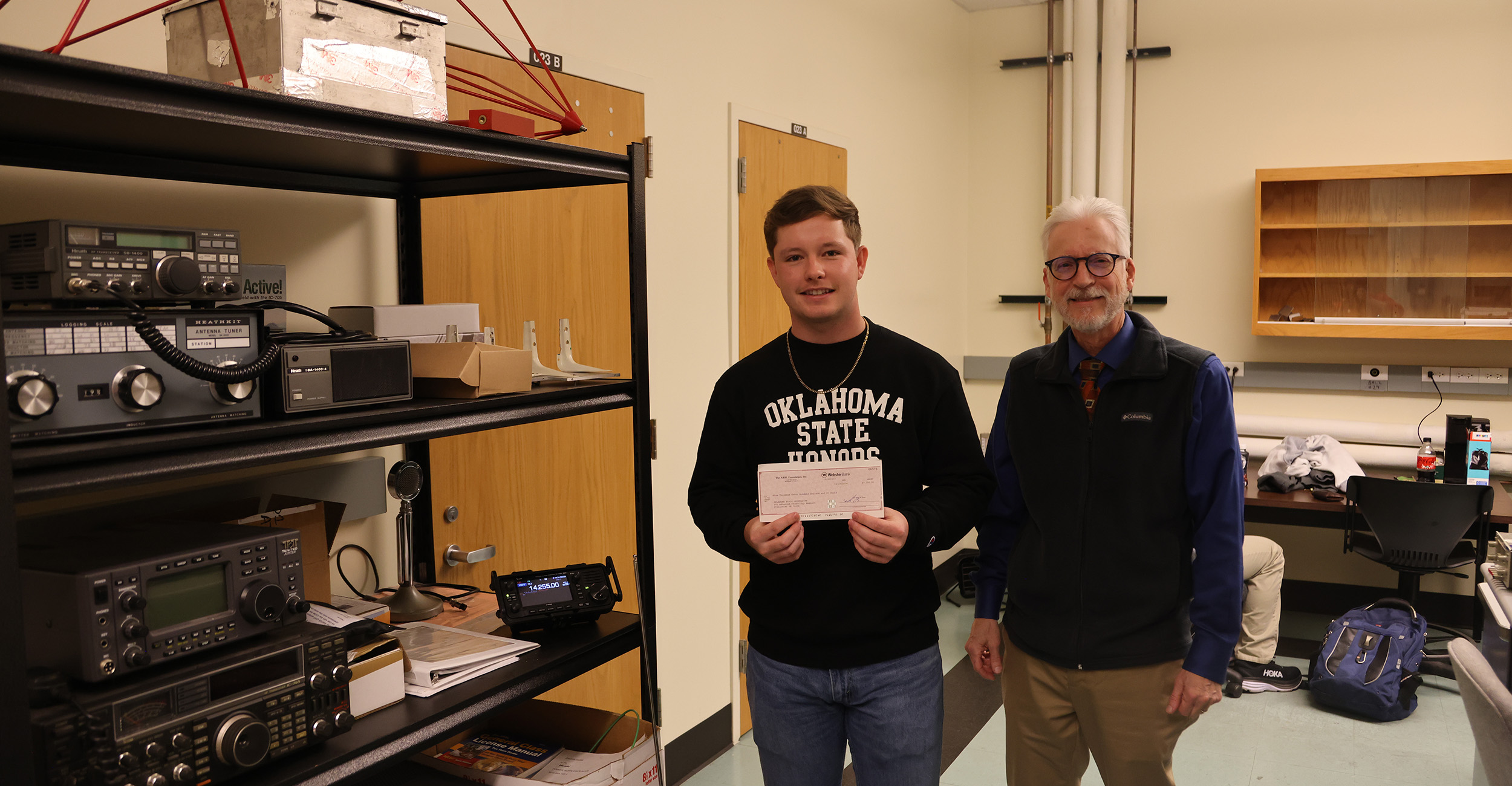
The club received $9,700 from the American Radio Relay League Foundation to help it
reform for the future. Advanced Technology Research Center room 023 will house the
club’s equipment and be the main meeting location during the spring semester. The
club may be relocated to a more visible location in the future.
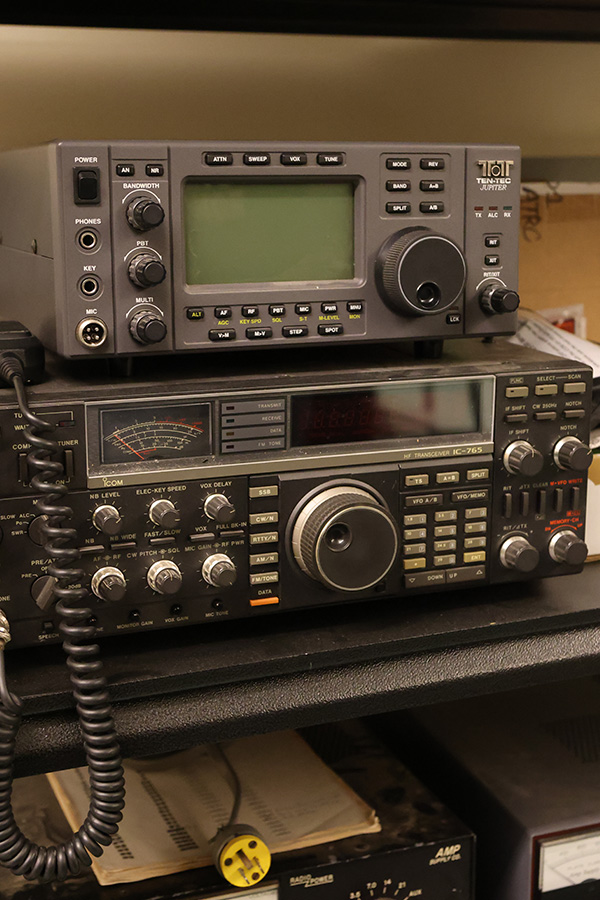
capacities.
Trey Dorrell, a senior mechanical and aerospace engineering major, is president of
W5YJ. He and the club recently participated in Winter Field Day 2025, allowing members
to showcase radio’s versatility and importance in a real-world scenario.
Dorrell was first introduced to amateur radio after getting his radio technician license
in 2023 while working for Cowboy Rocketworks. He needed a license to operate the flight
computers to track rockets.
He got a handheld radio and began using repeaters, an amateur station that receives
a signal on one frequency and simultaneously retransmitting it on another. By leveraging
this technology — similar in principle to the relay systems used in cellular radio
— he could extend his communication range and connect with Stillwater Amateur Radio
Club members. He then earned his general radio license, which allows a person to use
more operating modes and use the majority of the amateur spectrum below 30 megahertz.
He continued to gain experience with radio and sought advice from Dr. Chuck Bunting,
associate dean of research for CEAT, and Tim Sickbert, a lab coordinator in the Noble
Research Center, about reviving the club.
“Reforming W5YJ has been a mix of preserving its history and building something new,”
Dorrell said. “The most important part moving forward is getting the word out so students
can become involved. Securing funding has been a big step, but now it’s about encouraging
participation and creating a community.
“Once we have a solid group of active members, we can start expanding what the club
does, from hosting events and study sessions to organizing operating activities and
projects. Building involvement is the foundation for everything else we want to achieve.”
The club will invest in better equipment, organize more events and activities and
create a stronger presence on campus.
“This is a game-changer for the club and will help us have a much bigger impact moving
forward,” Dorrell said. “It will make it much easier for students to explore the hobby
without having to invest in their own radios right away.”
Much more than a hobby
Bunting, an OSU Amateur Radio Club advisor, was first exposed to shortwave radio as
a child visiting his grandparents’ home in Norfolk, Virginia. He still has the tube-type
Hallicrafters receiver that sparked his imagination in the 1960s, which led him to
electrical engineering and ultimately into electromagnetics.
Bunting earned his technician and general licenses in February 2021 and took to the
local and regional airwaves. Early on, he participated in “Nets,” which he described
as being like “radio chat groups” with various topics being discussed, all with the
goal of being on the air and communicating. Since 2021, he has had about 16,000 QSOs,
or people he has made contact with, in 140 countries.
Since then, he has been involved with K5SRC, the local amateur radio club in Stillwater,
and set out to help revamp the OSU club.
To Bunting, students engaging in radio provide opportunities in radio, radio science,
engineering and communication, and anyone can get as deeply involved as they choose.
“There are several research programs in engineering that require an amateur radio
license to operate transceivers, including the NASA CubeSat program and the OSU rocketry
club,” Bunting stated. “These often use APRS (automatic packet reporting system) –
a digital communication system that allows sharing of real-time information such as
GPS or weather data. Computers now intermingling with radios has unlocked a multitude
of possibilities.”
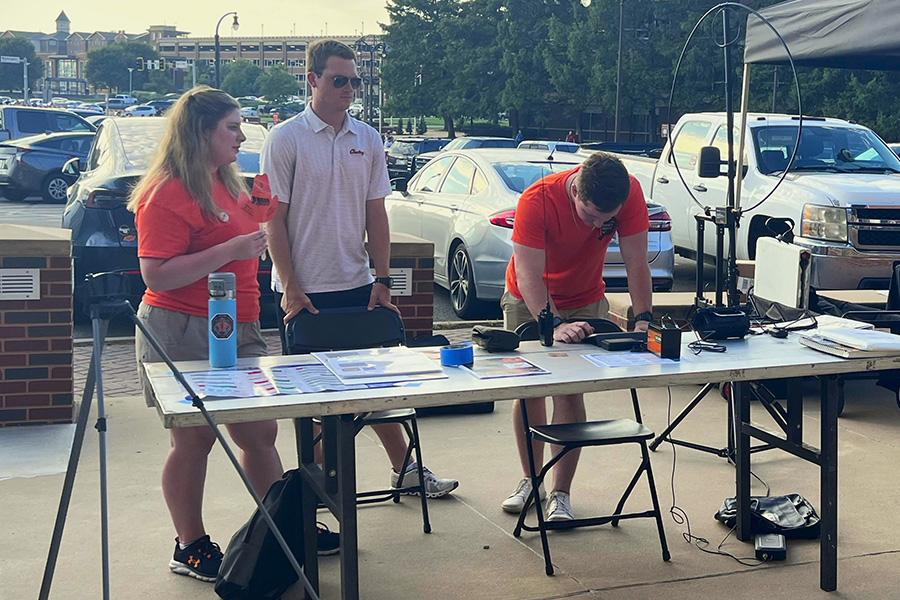
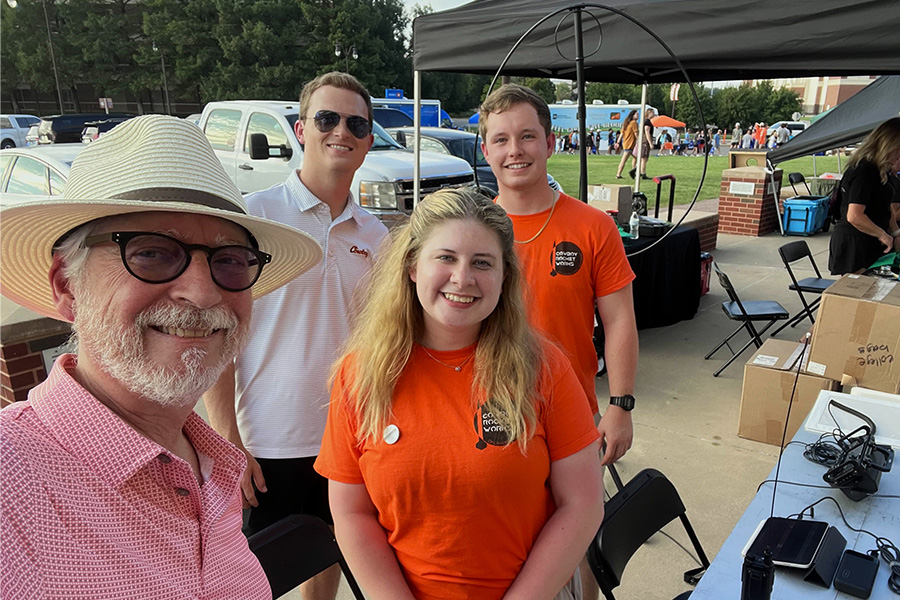
pictured during a showcase of the radio club on OSU’s campus.
Something for everyone
The OSU Amateur Radio Club is looking to recruit and retain members. It has 44 members
and counting and aims to showcase the organization’s fun and challenging aspects.
Dorrell said the club offers something for everyone by offering hands-on opportunities
to learn practical skills such as electronics, troubleshooting and problem solving.
It also introduces students to a global community connected by passionate radio enthusiasts.
“It’s not just a hobby — it’s a gateway to learning, networking and contributing to
real-world applications like emergency preparedness or community support,” Dorrell
said. “Overall, it’s an accessible and rewarding experience that builds skills for
both personal and professional growth.”
The club is open to all majors and will guide students on the fundamentals of radio
and the licensing process.
Once members get licensed, they can join the weekly network, a conversational meeting
held by radio using the club’s repeater. The club also has a portable radio that can
be set up for global communication, Morse code and digital modes, which allows text
and email to be sent over radio frequencies.
“We’re also looking to expand into exciting activities like communicating with the
International Space Station and practicing emergency preparedness,” Dorrell stated.
“And this is just scratching the surface of what the club has to offer.”
Paxton Bradford, the club’s vice president, is an MAE major expecting to graduate
in May 2026. He, like Dorrell, was introduced to radio while using an app to track
rockets with Cowboy Rocketworks.
He said the club is a great way to become involved with something fun and challenging
with his peers. It also is a way for students to learn outside of the classroom.
“The club is not only a great way to become involved with fellow students and even
faculty at the school, but it also allows opportunities for students to learn with
something that can be challenging but rewarding to master,” Bradford said.
Bradford suggests anyone interested in the club give it a try as it could be a useful
skill to learn that can set someone apart from other students.
“Members can do several different things with the club now, and the opportunities
for what they could do are nearly endless,” Bradford explained.
Landon Vogts, a senior MAE major, first learned the history of W5YJ through the archives
of the Daily O’Collegian on the Edmon Low Library’s website. He also watched Dorrell
make long-range contact with one of the club’s radios last year and jumped at the
chance to join the club.
“W5YJ can help OSU students learn about the hobby of a thousand hobbies that is amateur
radio,” Vogts said. “Members of W5YJ get to hang out with other hams, learn about
amateur radio, and, of course, operate the club’s radios. The easiest way to learn
about amateur radio with no experience, the way I did it, was to use the HamStudy
app on my phone. It has all the questions, answers, and explanations you need to pass
your exam and earn your license.”
The OSU Amateur Radio Club meets every Tuesday at 11:30 a.m. in ATRC 023. The meetings
are open to anyone and attendees learn of upcoming events and new members can receive
help in getting licensed. The club also hosts a weekly network on the 25YJ repeater
every Sunday at 7 p.m.
link
:quality(100) "5 Takeaways on Secure Communications from CGE Radio’s Conversation with BlackBerry")